B2B Exporter Website Development: A Practical Guide
A generic company website can make a capable exporter look unprepared. Exporter website development must do more than present a polished profile: it should help overseas buyers verify the supplier, assess product fit, and submit a commercially useful inquiry through one clear journey.
Plan the site around the questions buyers need answered. Product specifications, certification and Certificate of Analysis (COA) information, trade inquiry details, and clear contact routes all support evaluation. If these elements are missing or hard to find, buyers face friction before a conversation even begins.
This guide explains how to define a build around export sales requirements, choose technical and commercial capabilities, and move from discovery through launch. It covers how multilingual subfolder architecture can support international visibility, how an RFQ form can capture Incoterms, and where performance and verification features fit into the buyer journey. The goal is not simply a brochure redesign. It is a practical digital asset that connects buyer information, relevant inquiries, and cross-border access.
Key Takeaways
- Plan exporter website development around the full buyer journey, from supplier assessment to a qualified commercial inquiry.
- Structure the site around four requirements: buyer-facing content, international access, inquiry handling, and operational safeguards.
- Compare website approaches using practical criteria such as localization, specification presentation, inquiry routing, and security.
- Prepare product data, target markets, company credentials, inquiry ownership, and language priorities before development begins.
- Consider how multilingual subfolders, specification and COA showcases, Incoterms RFQs, and dual inquiry funnels can support cross-border business.
What Exporter Website Development Must Achieve for Overseas Buyers
Exporter website development is the design and construction of a digital system that helps overseas buyers assess supplier fit, review export-relevant evidence, and submit a commercially useful inquiry. A corporate brochure introduces a company; an exporter website organizes the information and actions buyers need to move from discovery to evaluation. It is commercial infrastructure, not just a visual refresh.
The site still relies on sound website development principles, including organized content, usable navigation, and reliable functionality. The export-specific difference is the buyer journey it supports. A procurement team may arrive through a product search, assess the supplier’s capabilities, examine specifications and supporting documents, then decide whether to submit an RFQ. Make each step easy to find and the next action clear.
How overseas buyers use an exporter website
Before committing time to a sales conversation, buyers need to know whether the supplier handles the product category they need, whether specifications match their requirements, what company and export information is available, and how to send their requirements to the right commercial contact.
These are buyer research needs, not reasons to prioritize internal brand preferences. A company may want its history or mission to lead, but a sourcing team often needs product data, available documentation, and a direct inquiry route first. Organize information around the buyer’s evaluation task, then use company background to provide context.
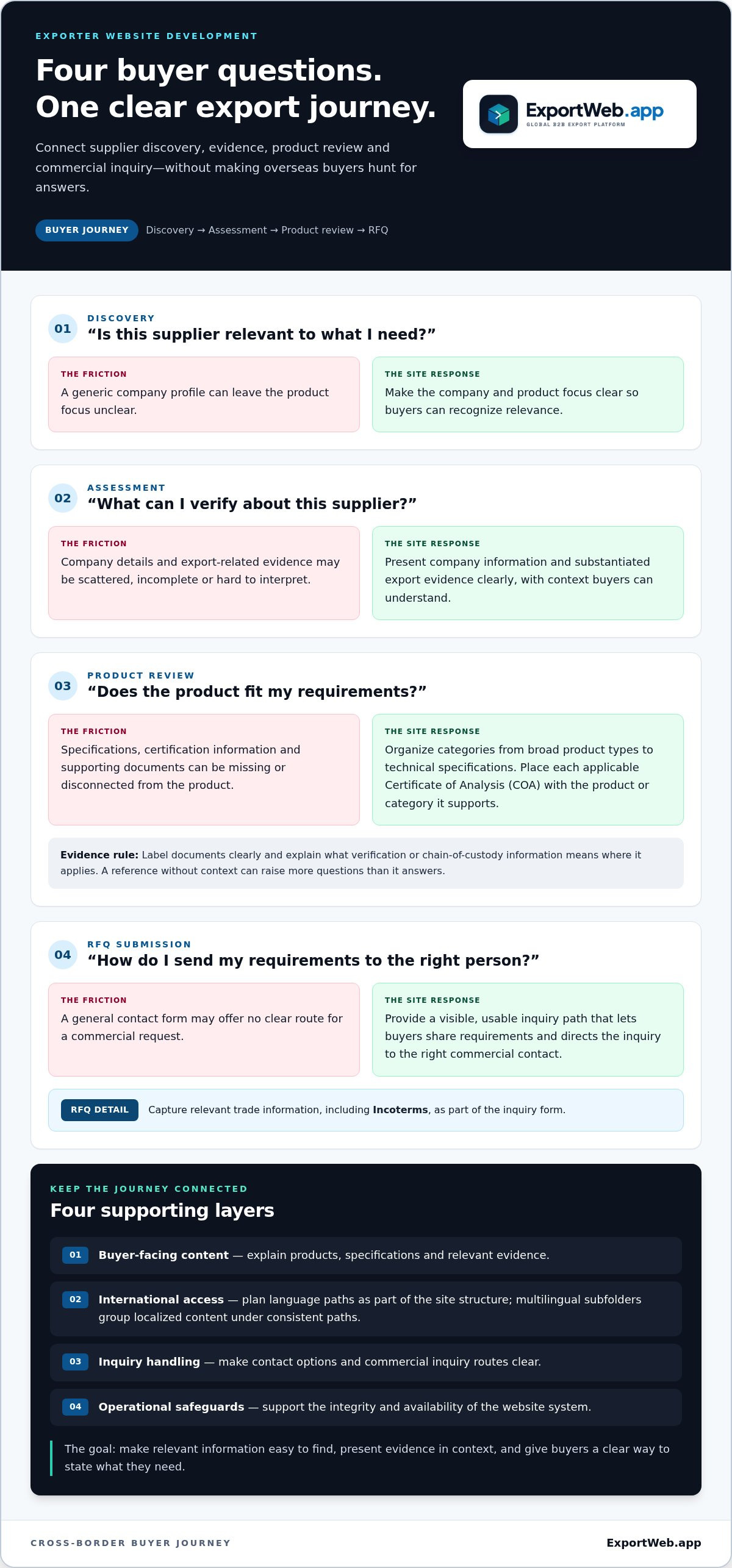
- Discovery: A clear company and product focus helps buyers recognize relevance.
- Assessment: Company details and export-related evidence support supplier review.
- Product review: Accessible specifications and applicable certification information help buyers evaluate fit.
- RFQ submission: A visible, usable inquiry path lets buyers communicate their requirements.
When these elements connect, buyers can move through their evaluation with fewer avoidable uncertainties. The website does not establish trust on its own, but accurate evidence and clear information give buyers a stronger basis for assessment.
Why a generic business website can fall short
A generic site may describe the company well while leaving export-critical information scattered, incomplete, or difficult to act on. Product pages might omit specifications; certification references might lack context; contact details might lead only to a general form with no clear route for a commercial RFQ. Each gap makes the buyer work harder to get answers.
Visual polish cannot make up for missing commercial evidence. Nor does an attractive layout prove product suitability, export capability, or responsiveness. Effective exporter website development connects company information, product review, and inquiry handling in one usable path, using content the business can substantiate.
The standard is straightforward: make relevant information easy to find, present evidence in context, and give buyers a clear way to state what they need. That creates a more useful evaluation experience without promising a contract or treating the website as a substitute for the supplier’s actual capabilities.
The Core Architecture Behind Effective Exporter Website Development
A reliable exporter website is built in layers. Buyer-facing content explains what the company supplies; international access organizes information for overseas audiences; inquiry handling gives buyers a practical way to get in touch; operational safeguards support the integrity and availability of the system. These layers depend on one another. A strong product page has limited value if buyers cannot find it, and a well-designed inquiry form cannot compensate for unclear product information.
Website architecture connects the information buyers need to evaluate a supplier with the pathways they need to make a relevant commercial inquiry. This is the organizing principle behind exporter website development: every page, document, language path, and contact option should have a defined role rather than existing as a disconnected feature.
Information architecture for products and export proof
Structure product pages around the way procurement teams distinguish offerings. Organize categories so buyers can move from a broad product type to the relevant technical specifications. Place a Certificate of Analysis (COA) with the product or category it supports, and label documents clearly so users understand their context. The aim is not to publish every file in one archive; it is to make relevant evidence accessible without requiring buyers to interpret an unstructured document library.
Where chain-of-custody information applies to a business’s processes, explain what is being traced and how the information relates to the product. Evidence should be specific and understandable. A certificate or verification reference without context can raise more questions than it answers.
International access and dependable inquiry paths
Plan language paths as part of the site structure, rather than adding translated pages in isolation. A multilingual subfolder architecture groups localized content under consistent paths, helping users and search systems distinguish language versions. Each version should preserve the same basic content logic while presenting information in the selected language. Translation alone is not localization: navigation labels, product terminology, and inquiry prompts must also make sense to the intended audience.
Contact routes can serve different needs. An integrated commercial RFQ form can collect structured requirements, while WhatsApp can support buyers who prefer a direct sales conversation. A general contact route can handle other messages. Clear labels help buyers choose the right path; clear ownership within the business helps ensure inquiries reach the responsible team.
- Content layer: Product categories, specifications, and related export documentation.
- Access layer: Language paths and navigation that keep localized information coherent.
- Inquiry layer: RFQ forms and alternative contact routes matched to buyer intent.
- Safeguard layer: Bot protection and delivery infrastructure that support reliable site operation.
A global content delivery network (CDN) distributes site assets through infrastructure designed to support access across regions. Bot protection helps limit automated abuse of site functions. Neither feature guarantees sales or inquiry quality; each supports the dependable operation of the wider system. For exporters considering a purpose-built approach, ExportWeb.app’s dedicated exporter website architecture brings content, inquiry, and infrastructure decisions into one build.
Custom Exporter Website or Generic Builder: How to Compare the Approaches
The right build depends on operational requirements, not a blanket preference for templates or custom code. A template-led site can provide a functional starting point. General custom development can address broader business requirements. Exporter-focused development organizes the build around overseas buyer evaluation, export documentation, localization, and commercial inquiries. Compare each approach by whether it supports the company’s sales process without adding unnecessary complexity.
Use the same criteria for all three: how easily the team can maintain product content, how language versions are structured, how technical proof is presented, where inquiries go, and whether the architecture can accommodate future requirements. The scope of exporter website development should fit the business. Not every exporter needs a complex catalog or tailored inquiry workflow.
When a template-led site may be sufficient
A template may suit an exporter with a small, stable product range, one primary market, limited documentation, and a straightforward contact requirement. It can establish a basic presence without specialized workflows. The trade-off is flexibility: as language paths, product evidence, or structured RFQs become more important, the business may need to adapt the template or work around its limits. That is a scope decision, not a verdict on templates as a category.
When exporter-specific development adds operational value
More tailored architecture becomes useful when buyers need to navigate a complex catalog, review technical proof across products, access localized content, or submit structured RFQs. It can also distinguish inquiry paths by readiness: a buyer with defined specifications can use an RFQ, while an earlier-stage prospect may prefer a direct sales contact. Add structure to solve a real workflow need, not for customization’s sake.
| Criterion | Template-led | General custom | Exporter-focused |
|---|---|---|---|
| Scope | Basic company and product presence | Requirements tailored to broader business needs | Architecture shaped around export sales and buyer evaluation |
| Localization | May support basic translated pages | Can be designed for selected languages and markets | Plans language paths and subfolders as part of the site structure |
| Proof | Standard page or file placement | Flexible content layouts | Product specifications and certification information organized in context |
| Inquiry handling | Typically a general contact route | Forms and routing shaped to project needs | Commercial RFQ and alternative inquiry paths aligned to buyer intent |
| Extensibility | Bound by the template’s available structure | Built around defined custom requirements | Designed to accommodate export-specific content and workflows |
Use the comparison to separate requirements that are essential now from those that can wait. If buyers need only a concise company profile and a simple contact route, a template may be proportionate. If the sales process depends on product-level evidence, multiple language paths, and structured inquiries, an exporter-focused build can align the site more closely with those operations. The strongest choice serves the actual workflow without adding complexity the business cannot use.
Planning Exporter Website Development: Discovery to Launch
A controlled project starts with commercial requirements, not page design. Before development begins, define the target markets, buyer priorities, product data, company evidence, language priorities, and the people responsible for each inquiry. These inputs shape the site structure, content workload, form logic, and launch criteria. Without them, teams risk building pages that look complete but leave important content or ownership decisions unresolved.
- Set commercial goals. Identify the markets and buyer segments the site must serve, the product lines to prioritize, and the action buyers should take, such as requesting a quotation or contacting sales.
- Map buyer requirements. Document the questions buyers ask when evaluating suppliers. Use them to define required company information, product details, and supporting evidence.
- Inventory source material. Gather current product data, specifications, applicable certificates, company information, and existing translated content. Assign someone to validate each item.
- Define language and inquiry scope. Select launch languages and identify who reviews each version. Name the team or role responsible for receiving and handling each inquiry type.
- Build and populate. Develop the agreed architecture, add approved content, and configure contact routes. Separate essential launch functions from enhancements that can be scheduled later.
- Test, launch, and refine. Validate the full buyer path before publication, then review site activity and operational feedback after launch to identify friction and prioritize improvements.
Set scope around export markets and sales operations
Prioritize requirements by commercial relevance. A product line central to a target market may need detailed technical content at launch, while a less strategic offering can follow later. Apply the same discipline to language coverage and features: launch with the paths buyers need and assign clear ownership. Product managers should validate specifications, designated staff should review certificates and company evidence, and language reviewers should approve localized content. Clear responsibility helps prevent outdated information from reaching buyers.
Validate the build before and after launch
Test real tasks, not just page appearance. Submit test RFQs and verify that each reaches its intended owner. Check language paths, document access, and WhatsApp handoffs. Review key pages on mobile devices and test them under representative international network conditions. Confirm that security safeguards are active and forms remain usable.
- Product details and company evidence are accurate and approved.
- Forms route to the correct inquiry owner, with clear confirmation for the user.
- Language navigation, document links, and contact paths work as intended.
- Key pages and forms remain usable on mobile devices.
- Security protections are in place before launch.
After publication, use observed page journeys and feedback about inquiry handling to refine navigation, content, or form questions. This supports operational improvement, but cannot guarantee contracts or export results. For a build planned around your markets, content, and sales workflow, see ExportWeb.app’s exporter website build.
How ExportWeb.app Builds an Exporter Website for Cross-Border Business
ExportWeb.app builds dedicated websites for B2B manufacturers and exporters, bringing export content, buyer inquiry workflows, and supporting infrastructure together. The build follows the overseas buyer’s evaluation process: find a relevant product, review its specifications and supporting evidence, then choose an appropriate way to contact the commercial team. Exporter website development is therefore an operational project, not simply a redesign of a corporate homepage.
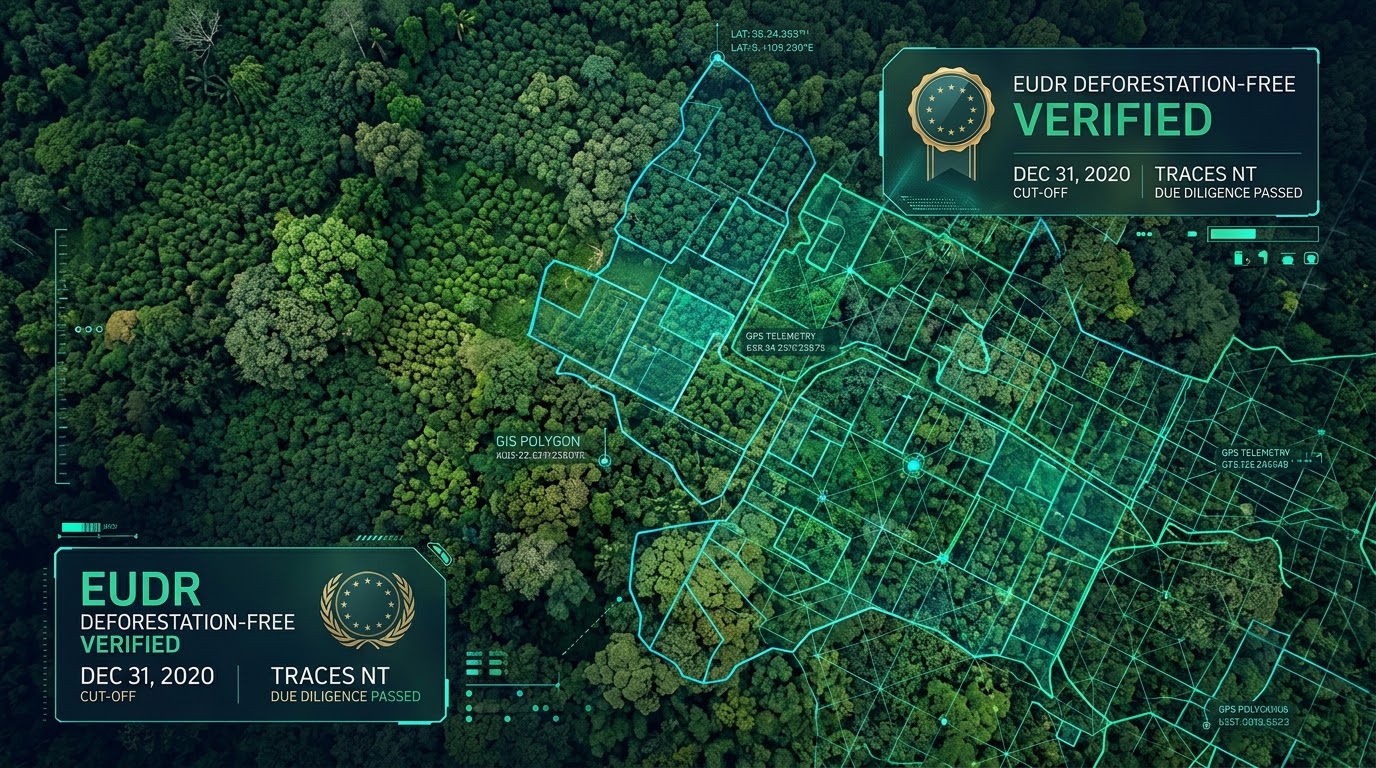
Its multilingual subfolder architecture gives language versions a defined place within the site structure. Product specification and certification showcases organize technical information for review, while Certificate of Analysis (COA) materials can be presented in relation to the relevant products. Where traceability information is relevant, chain-of-custody verification gives buyers information about product provenance. These features support evaluation; accurate source data remains essential.
Export-focused capabilities within the build
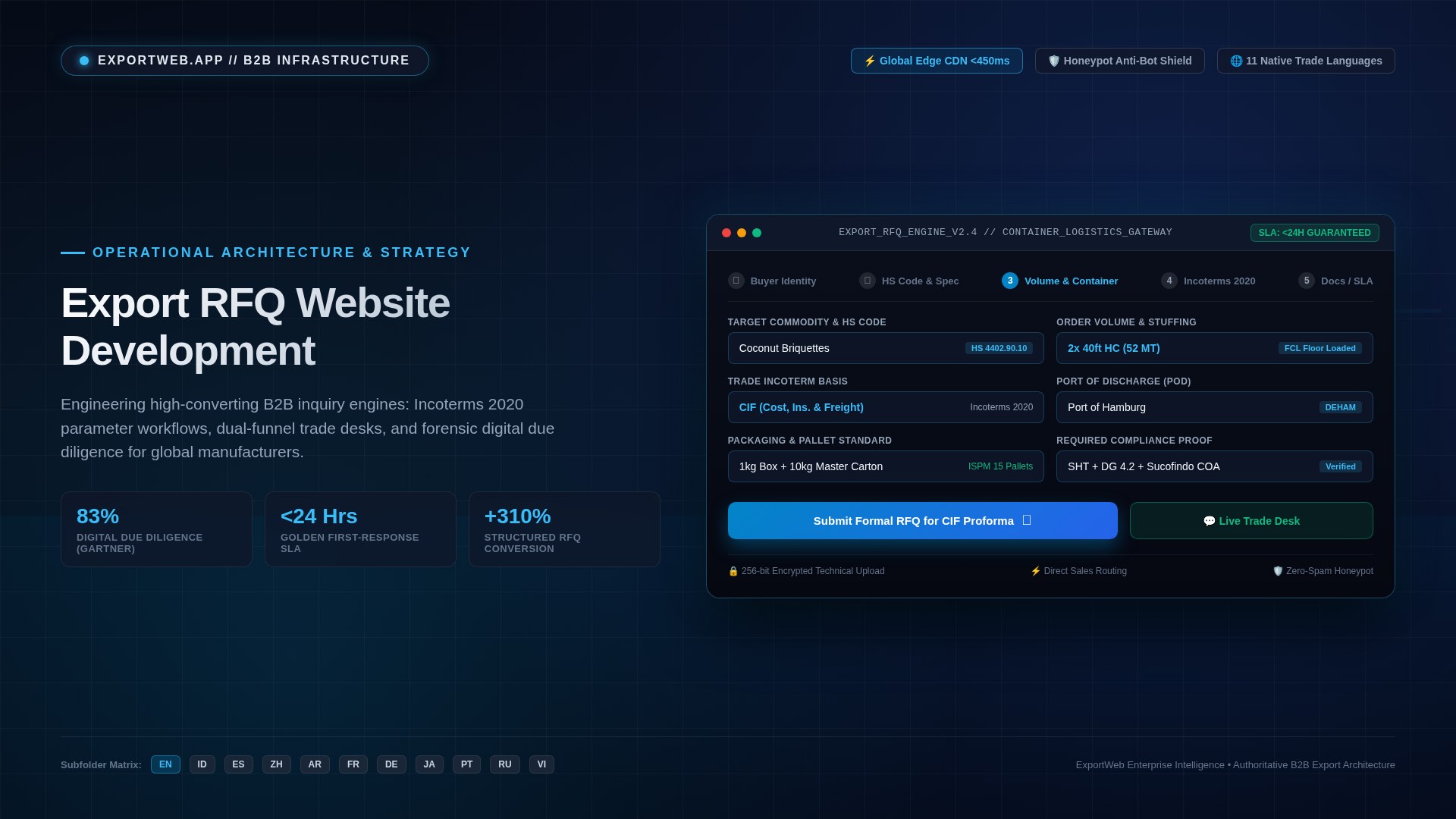
Commercial inquiry paths address different buyer needs. Commodity RFQ forms can capture trade terms such as FOB, CIF, and CFR, helping buyers express the basis of a request. An integrated WhatsApp sales desk provides a direct contact route for buyers who prefer a conversation. Together, these dual inquiry funnels distinguish structured quotation requests from other sales discussions and give the business a clear framework for handling incoming messages.
Bot protection helps defend inquiry forms and other site interactions from automated abuse. Global edge delivery supports access for overseas visitors. ExportWeb.app advertises sub-450ms global edge latency. Neither infrastructure feature guarantees qualified inquiries or commercial results.
ExportWeb.app also advertises a 14-day turnkey production sprint. For planning, define the target markets, product content, proof materials, language paths, and inquiry workflows the build needs to address.
Define the next step for your exporter website
Before implementation, outline the target markets, priority product lines, language requirements, and inquiry actions your team needs the site to support. Identify which product specifications and certificates are ready for publication, and who will own RFQs and direct sales conversations. These inputs shape a build around actual commercial requirements rather than assumptions.
For an overview of the approach, review ExportWeb.app’s exporter website build. A focused starting brief gives the project a clear basis for architecture and production.
Explore exporter website development.
Make Your Next Export Website Decision Deliberate
Turn commercial priorities into a clear digital brief. Identify which buyers the site must serve, what they need to assess, and how your team should receive and handle inquiries. That brief gives exporter website development a practical foundation and keeps the build aligned with real sales operations rather than internal design preferences.
ExportWeb.app develops dedicated websites for B2B manufacturers and exporters, connecting export-focused content and inquiry requirements within a purpose-built project. The result is a digital asset your team can use to present its business clearly and support buyer evaluation across markets.
Bring your target markets, priority products, and inquiry requirements into the planning conversation. Plan an exporter website built for cross-border inquiries.
Frequently Asked Questions
How much does exporter website development cost?
ExportWeb.app charges project-based fees for dedicated exporter website builds. Scope affects the work involved, including catalog size, language requirements, documentation, and inquiry functionality. Define these requirements before comparing proposals so you can assess what each build covers. ExportWeb.app advertises a 14-day turnkey production sprint; the schedule describes production, not commercial results.
Can a website guarantee leads or export contracts?
No. A website can present relevant information, make supplier evaluation easier, and provide usable inquiry routes, but it cannot guarantee leads, contracts, or export outcomes. Results also depend on factors beyond the site, including product-market fit, pricing, sales follow-up, and buyer requirements. Measure whether the site supports the intended commercial process, such as whether qualified visitors can find product details and submit complete requests.
Is a generic website template enough for an exporter?
It can be enough when the business needs a basic company presence, has a limited product range, and uses a simple contact route. A template may become restrictive if buyers need to compare technical product data, access localized content, or submit structured RFQs. Decide based on required workflows, not on whether a site uses a template. The build should support current sales needs without adding features the team will not maintain.
Do exporters need a separate website for every target market?
No. One website can serve multiple markets through clearly organized localized sections, such as language-specific subfolders, when the content and navigation suit those audiences. Separate websites may be appropriate when market requirements, brands, or product offerings differ substantially, but they also create more content to manage. Start by mapping the information each audience needs, then choose a structure that keeps updates accurate and language versions easy to maintain.
What information should an exporter prepare before website development begins?
Prepare a current product catalog, approved specifications, available COA or certification files, company information, target markets, and priority languages. Also identify who owns product accuracy and language review, and who receives each inquiry type. For example, if RFQs and general sales questions go to different teams, define that routing before forms are built. A clear source of truth for product data helps prevent conflicting details across pages.
Can an exporter website display product specifications and COA certificates?
Yes. Product specifications and COA certificates can appear in the context of a product or category, helping buyers understand which information relates to the item they are reviewing. Use consistent labels, keep documents accessible, and assign an owner to review published material when source documents change. ExportWeb.app builds specification and certification showcases for exporter websites. Published details should accurately reflect the exporter’s approved product information and documentation.
What should exporters measure after launching a new website?
Track whether the site is serving its intended sales process, not just how many visitors it attracts. Review visits to priority product pages, use of language paths, RFQ submissions, form completion issues, and whether inquiries contain useful purchasing details. Monitor where visitors leave key journeys and whether inquiries reach the right team. Use these findings to refine navigation, page content, and form fields, then compare performance over time.